🔒 Our Favourites
Discover or re-discover various apps and sites ideas!

Discover or re-discover various apps and sites ideas!
Dans chaque numéro du magazine, on vous propose une sélection de sites et applications à découvrir! Découvrez notre sélection de l’hiver.

Whether you teach languages, mathematics, arts, sciences, ethics, social studies or physical education, there are various ways to assess students’ progress besides regular quizzes, dictations or written tests. Nowhere in modern curricula is it requested from teachers to use those as the sole means of evaluation. Let’s get creative and try ideas gathered by educators from Sir Wifrid Laurier School Board.
Les Vignettes de pédagogie active, les billets de sortie, l’entretien (ou entrevue) entre élèves ou avec l’enseignant(e) et l’enregistrement audio ou vidéo sont d’autres façons de recueillir des traces d’apprentissage! On vous en dit plus!
This article contains all the references of EngagED Learning Magazine, Volume 2 issue 2, Winter 2022-2023. 6 Things You Should Know about Evidence of Learning References: Campus RÉCIT. Évaluer à l’aide du numérique, 3.3 La triangulation des preuves d’apprentissage à distance. https://campus.recit.qc.ca/mod/tab/view.php?id=10765#tab493 Campus RÉCIT. S’organiser et garder des traces avec OneNote. https://campus.recit.qc.ca/course/view.php?id=279 Centre franco-ontarien de […]
Compléments et références du magazine, Vol. 25 no 2 (hiver 2022-2023)
Longtemps associé à une forme d’élitisme, la douance est de plus en plus reconnue dans les écoles. Avec ce dossier, nous souhaitons la démystifier un peu, en plus de favoriser la mise en place de pistes d’intervention pour répondre aux besoins particuliers de ces élèves. Nous présentons également des exemples de projets existants dans des écoles québécoises.

Educational research is a very dynamic field. A lot of action research and increasingly more collaborative research (which means that classrooms are welcoming research teams) is occurring everywhere. However, the results do not often leave the inside of the walls of universities and research centres so that it can be applied in schools. This is not because of lack of interest in doing so, but mostly because there is a reluctance and a fear of dogmatism.

The PÉRISCOPE network, which has been holding panels about the inequalities and inequities exacerbated by Covid-19 since the spring of 2020, is interested in peer feedback as a promising course of action. Feedback is provided when one person provides information to another to help them better understand, behave better, or progress in an activity. What we mean here by “augmented feedback”, is feedback given verbally or in writing, supported by a digital tool during a learning and evaluation situation (LES).

Teachers and parents play a crucial role in helping young people to develop the foundational digital skills and social practices that enable them to become critical readers, writers, and participants in a complex world where digital technologies shape how we think, understand and interact. Here are three strategies that teachers and parents can use to support digital literacies learning.

Reconciling multidisciplinary learning and the integration of digital productions in partnership with pre-service teachers, is what sixth-grade elementary school teacher Jean-François Mercure and Professor Séverine Parent accomplished during the winter of 2022.
Technology, in its many forms, has been present in the classroom since the introduction of the blackboard, followed decades later by the overhead projector. Now, in our digital age, classroom environments can always be connected to the Internet, and educators need to make choices about both hardware and software.

Reading fluently is being able to accurately identify written words with precision, without using too many cognitive resources, and by understanding the tone in a manner to build a solid comprehension of the text. Reading fluently is one of the key dimensions of learning to read with success.

Digital technology is ubiquitous. We have been increasingly reliant on smartphones, tablets and computers over the past 20 years, and this trend has been accelerating due to the pandemic. Conventional wisdom tells us that over-reliance on technology may take away from our ability to remember, pay attention and exercise self-control. Indeed, these are important cognitive skills. However, fears that technology would supplant cognition may not be well founded.
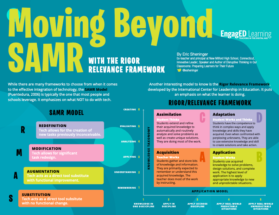
While there are many frameworks to choose from when it comes to the effective integration of technology, the SAMR Model is typically the one that most people and schools leverage. It emphasizes on what NOT to do with tech. Another interesting model to know is the Rigor Relevance Framework, developed by the International Center for Leadership in Education. It puts an emphasis on what the learner is doing. While there isn’t a seamless alignment, Eric Sheninger attempted to connect them both.
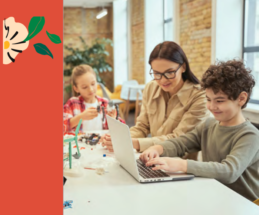
Education systems around the world are encouraging their schools to develop maker programs to enhance learning and skill development that prepares students for the 4th Industrial Revolution. Through maker education, students develop a plethora of skills and STEAM concepts. Ensuring that maker experiences live up to their potential can be difficult, however, as assessing student learning through maker projects and getting all stakeholders in education at the local and regional level on board can be challenging. In our study, we spoke to more than 30 experts in making and education.

Better student engagement during learning is an essential condition for developing skills. It is with this premise in mind that three projects mobilizing different parts of the Digital Competency Framework were introduced to the students participating in a course during the winter of 2022 as part of the Bachelor’s degree in sports activity and the Bachelor’s degree in physical education and health education at Université Laval.

In the État des lieux de l’enseignement du français (ELEF) survey, Lord and Chartrand (2010) reported that only 14% of teachers get students to use word processors for their writing often or very often, “more so to compile texts than to correct them”. Although ELEF data is revealing, it describes a situation that prevailed more than a decade ago. Have digital writing practices changed since then, particularly in the wake of the Plan d’action numérique (MEES, 2018)?

Integrating technological tools into a teaching approach is relevant when achieved in appropriate conditions. Here are some avenues that can serve as a basis to analyze their benefits and limits.

Teams. Zoom. Hybrid teaching. Asynchronous educational activities. Before March 12, 2020, these words were not part of the daily lives of the majority of elementary and secondary teachers, but COVID-19 has helped to make them of interest. The emergency shift to digital technologies disrupted the school’s activities; however, it also provided an unprecedented opportunity to promote their use in teaching and learning.